
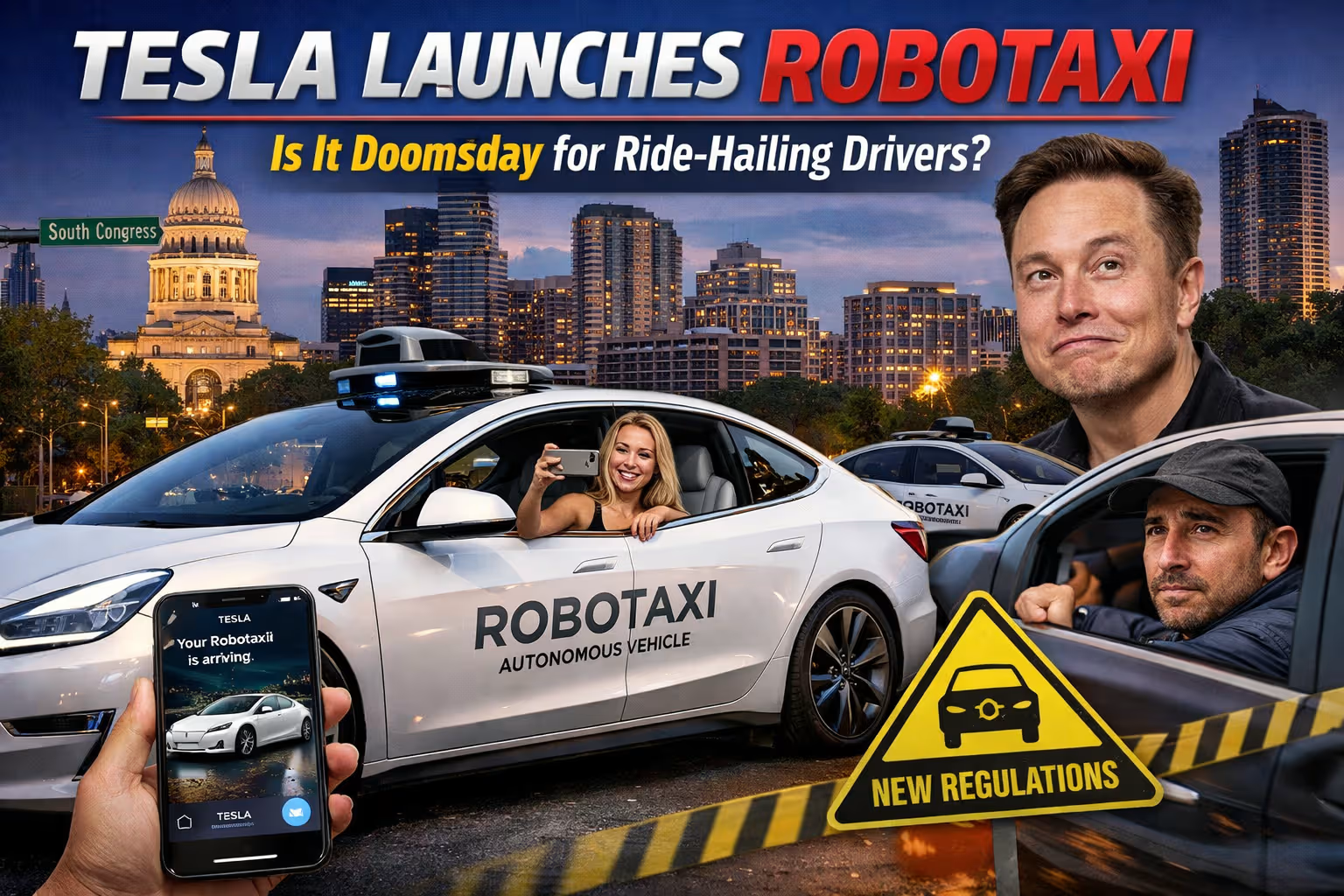
Just like Elon Musk promised, Tesla has officially begun operating its long-awaited driverless robotaxi service in Austin, Texas. For now, the rollout is still very limited, with only a small number of vehicles hitting the streets as part of an early-stage trial.
Unsurprisingly, Tesla didn’t launch quietly. The company appears to have teamed up with a group of influencers, many of whom flooded social media with their first-ever robotaxi experiences, documenting everything from booking the ride to cruising around Austin without a human driver behind the wheel.
The robotaxi launch marks a major milestone for Tesla. While competitors like Waymo and several Chinese companies have already deployed robotaxi services commercially, Tesla’s long journey to catch up finally seems to be paying off.
According to Tesla, the robotaxi project is the result of more than a decade of work. Elon Musk emphasized that both the AI software and custom chips powering the system were built entirely in-house, from scratch.
Over the weekend (Sunday, June 22 local time), multiple Tesla robotaxis were spotted in the South Congress area of Austin. The company is currently running a tightly controlled pilot involving around 10 vehicles. Interestingly, a passenger sits in the front seat acting as a “safety monitor,” although it’s still unclear how much control they actually have over the car.
In recent days, Tesla has sent exclusive invitations to select influencers to test the robotaxi within a restricted zone under strict supervision. The rides come with a flat fare of US$4.20 (around Rp69,000), a number Musk confirmed himself on X—yes, very on-brand.
Tesla investor and public figure Sawyer Meritt posted a video on X over the weekend showing the full experience: ordering the ride via Tesla’s robotaxi app, getting picked up, and heading to bars and restaurants—all without a human driver.
That said, Tesla’s robotaxi journey is far from smooth sailing.
For context, Waymo spent years refining its robotaxi operations due to major challenges around safety, regulation, and public trust. Tesla now faces similar hurdles—possibly even bigger ones.
Adding to the pressure, Texas officials moved quickly. Just days after Tesla’s robotaxi trial began, the state government pushed forward new regulations on autonomous vehicles.
Texas Governor Greg Abbott signed a bill on Friday (June 20) requiring companies to obtain state-level permits to operate fully driverless vehicles. The law will officially take effect on September 1, signaling that lawmakers from both political parties want the autonomous vehicle industry to move forward—but cautiously.
So while Tesla’s robotaxi debut is undeniably historic, the road ahead is still full of speed bumps. For now, the question remains:
Is this the future of transportation—or just another ambitious Musk experiment? 🚗🤖