

Xiaomi has officially kicked off 2026 by unveiling its latest midrange army: the Redmi Note 15 series. This time, Xiaomi didn’t hold back—four models launched at once: Redmi Note 15, Redmi Note 15 5G, Redmi Note 15 Pro 5G, and Redmi Note 15 Pro Plus 5G.
The Redmi Note lineup has long carried a reputation for being disruptive in the midrange segment, and this generation looks ready to do the same—whether it’s emptying your February red-envelope money, your March holiday bonus, or just slowly draining your wallet over the year. After all, people don’t buy phones based on the calendar, but on need, comfort, and sometimes… discounts on double dates.
That brings us to the most important question for phones in 2026:
Is the price still reasonable?
Prices Are Up—and There’s a Reason
Global RAM supply issues are still very real. They’ve already pushed laptop and smartphone prices upward, and even Xiaomi’s global leadership has openly stated that price increases were unavoidable. The Redmi Note 15 series is no exception.
Compared to last year’s Redmi Note 14 lineup, every single model launches at a higher price, from the base version all the way to the top-tier Pro Plus. The RAM market situation simply can’t be ignored—even by Xiaomi.
 That said, after testing and comparing specs, memory variants, and pricing, one model stands out clearly as the most balanced option:
Redmi Note 15 Pro 5G (8GB/256GB variant)
Its price increase feels measured. The jump is modest—roughly under 10% compared to last year—while the actual hardware upgrades land closer to 10–20%. In other words, the higher price feels justified by real improvements, not just market pressure or currency fluctuations.
Interestingly, Redmi Note Pro models have historically hovered around the same price bracket. From the Note 12 Pro to the 14 Pro, pricing has stayed surprisingly consistent. The Note 15 Pro continues that trend, suggesting Xiaomi priced this device carefully rather than aggressively.
Battery Life: The Biggest Upgrade This Year
If there’s one upgrade that almost everyone will appreciate, it’s battery life.
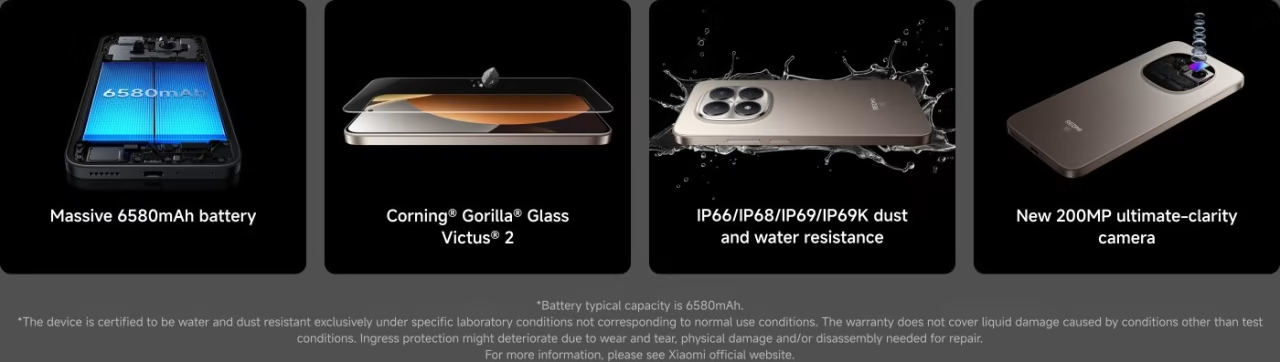
The Redmi Note 15 Pro jumps from around 5,100 mAh to a massive 6,580 mAh, thanks to higher-density silicon-carbon battery technology and a slightly larger chassis. The result is excellent endurance:
- One hour of indoor YouTube streaming over Wi-Fi: only ~6–7% battery used
- One hour of navigation with mobile data: ~8%
- 30 minutes of MLBB at 90 fps: ~8–9%
- 30 minutes of Genshin Impact: ~9–10%
Charging speed remains capped at 45W, similar to last year. Despite the much larger battery, a full charge only takes around 15–20 minutes longer than the previous model, which is still impressive. The phone can also act as a power source for other devices, delivering up to 22.5W reverse charging.
Bigger Screen, Bigger Debate
Not all upgrades are universally loved.
The Redmi Note 15 Pro is now bigger and heavier—around 210 grams—with a massive 6.83-inch display. That makes it the largest Redmi Note ever, approaching the size of older compact tablets.
Some users will love this for media consumption and gaming. Others may find it unwieldy. The flatter frame and flat display improve durability and accessory compatibility, but handling requires more effort, especially for one-handed use.
Display quality itself is excellent:
- Flat AMOLED panel
- 1.5K resolution with high pixel density
- 120Hz refresh rate
- High brightness for outdoor use
- Support for Dolby Vision and HDR10+
- Protected by Gorilla Glass Victus 2
One lingering issue remains on the software side: refresh rate optimization. Some apps, like YouTube, still don’t dynamically switch between 60Hz and 120Hz as expected unless manually forced—an old midrange Xiaomi quirk that still hasn’t been fully resolved.
Performance: Safe and Predictable
The chipset upgrade is modest. Xiaomi moves from the Dimensity 7300 Ultra to the 7400 Ultra, offering slightly higher clock speeds but no major performance leap. Benchmark scores remain in the same general range.
For gaming:
- Light titles run smoothly
- MLBB can hit high frame rates depending on settings
- Heavy games like Genshin Impact run at lower settings and around 35 fps
- Thermals stay controlled, with temperatures hovering around the low 40s Celsius—warm, but not alarming.
- Cameras: Reliable, Not Revolutionary
The Redmi Note 15 Pro sticks with a 200MP main camera with OIS, paired with an 8MP ultra-wide sensor. Image quality remains sharp, colorful, and reliable across lighting conditions. Xiaomi’s sensor-cropping system helps maintain detail when zooming, especially compared to standard digital zoom.
The ultra-wide camera is serviceable but clearly behind the main sensor in detail—typical for this segment. Nothing surprising here, but nothing disappointing either.
Front video recording tops out at 1080p 60fps with solid stabilization, making it suitable for casual vlogging and daily use.
Final Verdict
The Redmi Note 15 Pro 5G doesn’t try to reinvent the formula—and that’s exactly why it works.
Yes, prices are higher. But the increase feels logical, supported by meaningful upgrades, especially in battery life and display quality. If you enjoy large screens, long battery endurance, and a balanced all-rounder experience, this phone offers strong value in the midrange segment.
If you dislike oversized phones, the design could be a deal-breaker. But when it comes to battery life, very few will complain.
Once again, Xiaomi proves that even in a tougher market, the Redmi Note Pro line remains easy to recommend for anyone looking for a dependable midrange smartphone in 2026.